


Introduction To 39180-2B000 Crankshaft Position Sensor
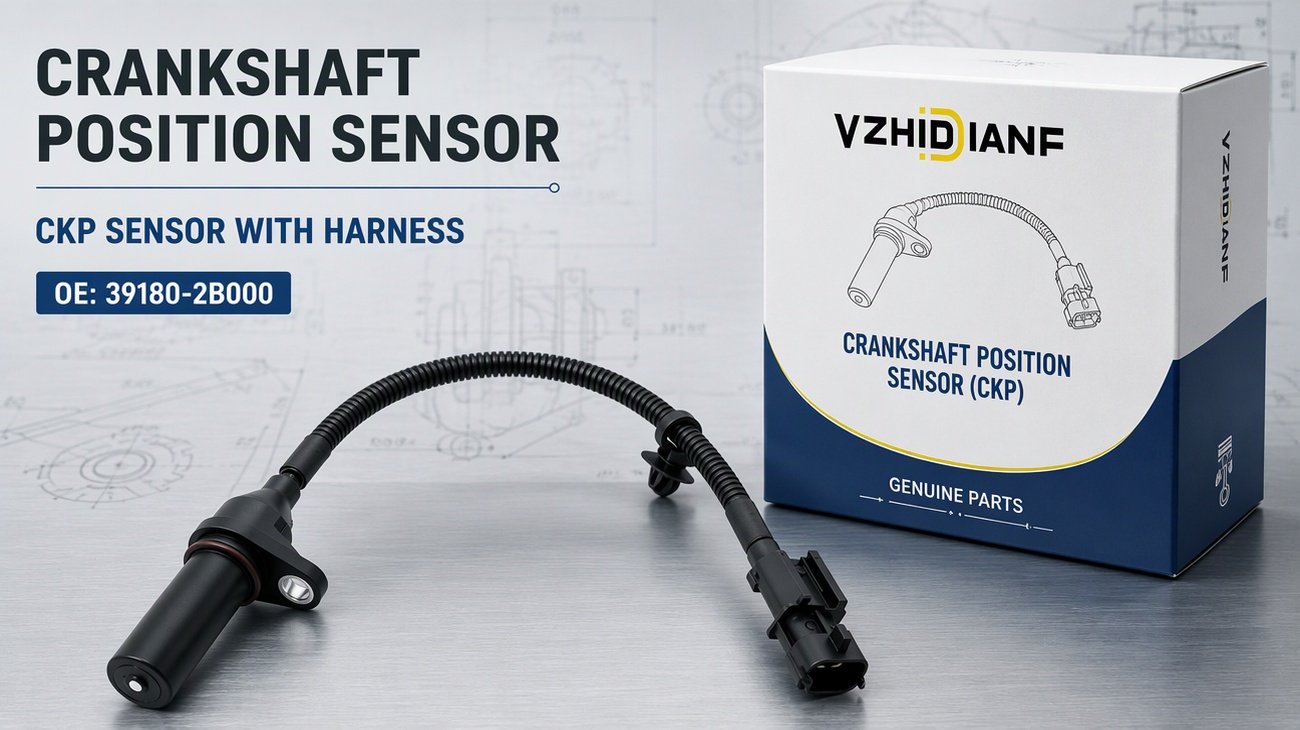
Le 39180-2B000 is an standard 2-pin engine crankshaft position (CKP) sensor assembly engineered specifically for modern inline-4 gasoline powertrains across popular compact, sedan, and crossover platforms. Serving as a direct aftermarket replacement for reference part numbers 39180-2B000 (interchangeable with 391802B000) and aftermarket cross-reference codes PC934, 5S12470, SU13885, 907-787, and 180-0735, this precision sensor includes an integrated mounting flange, pre-lubricated high-temperature Viton sealing O-ring, heat-resistant corrugated wiring loom, and a weatherproof 2-pin male connector. It is engineered for exact mechanical and electrical compatibility with for Hyundai (Accent, Elantra, Elantra GT, Veloster, Tucson, Venue, Kona) and for Kia (Soul, Forte, Forte5, Forte Koup, Rio, Seltos, Carens).
39180-2B000 utilizes high-permeability magnetic core inductive sensing technology. Mounted on the engine block adjacent to the flywheel / flexplate reluctor ring, the sensor detects passing tone-wheel teeth to generate accurate alternating frequency voltage signals for the Engine Control Module (ECM / PCM). The engine computer continuously processes these high-speed signals to compute real-time engine rotational speed (RPM), determine cylinder #1 Top Dead Center (TDC) position, coordinate sequential multi-point / direct fuel injection (GDI / MPI), and regulate Dual Continuously Variable Valve Timing (D-CVVT).
Compatibilité des véhicules et liste de références d'équipement d'origine
Vous trouverez ci-dessous la liste complète des véhicules concernés ainsi que les références des pièces d'origine interchangeables, pour vous permettre de vous y retrouver rapidement.
| Vehicle Make | Modèle de véhicule | Années-modèles | Displacement |
|---|---|---|---|
| Hyundai | Accent | 2011–2022 | 1.4L / 1.6L |
| Hyundai | Elantra (Sedan / Coupe / GT) | 2011–2020 | 1.6L / 1.8L / 2.0L |
| Hyundai | Veloster | 2012–2017 | 1.6L |
| Hyundai | Tucson | 2014–2021 | 1.6L / 2.0L |
| Hyundai | Venue | 2020–2023 | 1.6L |
| Hyundai | Kona | 2018–2021 | 1.6L / 2.0L |
| Kia | Âme | 2010–2021 | 1.6L / 2.0L |
| Kia | Forte / Forte Koup / Forte5 | 2011–2020 | 1.6L / 1.8L / 2.0L |
| Kia | Rio | 2012–2022 | 1.4L / 1.6L |
| Kia | Seltos | 2021–2023 | 1.6L / 2.0L |
| Kia | Carens / Rondo | 2013–2018 | 1.6L / 2.0L |
| OE Part Numbers: | 39180-2B000 / 391802B000 / PC934 / SU13885 | ||
Compliance Notice: All vehicle brand names, model designations, and engine codes listed below are referenced strictly to provide technical fitment and compatibility information.
Wholesale Trading Terms
Quantité minimale de commande
Our 39180-2B000 crankshaft position sensor(CKP), standard minimum MOQ is 10 pieces per model. We also accept mixed orders of different sensor models to meet your diverse sourcing needs.
Délai de livraison
For all in-stock crankshaft position sensor(CKP), we can arrange shipment within 3-7 business days. For large-volume wholesale orders, the production and delivery cycle is approximately 20 to 25 business days.
Politique de garantie
All 39180-2B000 crankshaft position sensor(CKP) come with a 12-month factory quality warranty. If any manufacturing defects occur during the warranty period, we will provide a free replacement.
Service OEM et de marque de distributeur
Nos emballages de marque peuvent être personnalisés en termes de dimensions, de matières premières et de procédés de conditionnement afin de répondre aux besoins des différents marchés régionaux. De plus, nous proposons des partenariats de production flexibles et fiables aux grossistes, distributeurs, acheteurs en gros et sociétés commerciales du monde entier. En résumé, nous proposons un service complet de marque de distributeur, comprenant la gravure laser de logos, la personnalisation des étiquettes de produits, la mise en sachets plastiques scellés et l'impression de boîtes en couleur.

Lignes directrices pour l'installation par des professionnels
- Safety Preparation: Switch off the ignition, engage the parking brake, and disconnect the negative battery terminal.
- Locate Sensor Assembly: Raise and safely support the front of the vehicle. Locate the CKP sensor mounted on the lower rear/front of the engine block near the transmission bellhousing.
- Disconnect Electrical Connector: Follow the attached wire harness pigtail upward to the main engine harness bracket and depress the locking tab on the 2-pin connector.
- Remove Mounting Bolt & Old Sensor: Unbolt the single 10mm retaining bolt securing the sensor flange to the engine block. Gently twist and pull the sensor body out of its mounting bore.
- Clean Bore & Lubricate O-Ring: Inspect and clean the mounting hole of any dirt, grit, or old oil sludge. Apply a light coat of fresh engine oil to the Viton O-ring on the new 39180-2B000 sensor.
- Install New Sensor: Insert the new sensor straight into the bore until the flange seats flush against the engine block. Reinstall the 10mm bolt and torque to specification (approx. 8–10 Nm / 71–88 in-lbs).
- Clip Harness & Reconnect: Secure the pigtail harness into all factory retention brackets to avoid contact with moving drive belts or hot exhaust components. Reconnect the 2-pin plug, reconnect the battery terminal, start the engine, and clear any stored fault codes with an OBD-II scan tool.
Centre d'aide
FAQ
Q1: What primary role does the 39180-2B000 crankshaft sensor play in for Hyundai and for Kia Gamma / Nu engines?
A: On for Hyundai and for Kia 1.4L, 1.6L, 1.8L, and 2.0L engines, 39180-2B000 reads reluctor wheel teeth to provide engine speed and TDC position. The PCM utilizes this AC signal to control ignition timing, fuel injector pulsing, and synchronize Dual-CVVT camshaft phasing.
Q2: What are the most common symptoms and trouble codes when a 39180-2B000 sensor begins to fail?
A: Common symptoms include extended engine cranking, sudden stalling when idling at stoplights, tachometer dropping to zero, and sluggish acceleration. It frequently triggers diagnostic trouble codes P0335 (Crankshaft Position Sensor A Circuit) and P0336 (Range/Performance).
Q3: Why does the 39180-2B000 sensor often fail intermittently after the engine reaches operating temperature?
A: Mounted low on the engine block near the exhaust manifold, internal copper coil windings experience intense thermal stress. Thermal expansion causes microscopic internal fractures in the inductive winding, cutting the circuit until the engine cools down completely.
Q4: How can technicians verify the integrity of the 39180-2B000 sensor using a digital multimeter?
A: Set the digital multimeter to ohms (Ω) and measure resistance across the two terminal pins at room temperature (20°C / 68°F). A healthy sensor displays between 850 Ω and 1,200 Ω. An open circuit (infinite resistance) or out-of-spec reading indicates internal winding failure.